The Essence of Precision and Style
Anyone talking about the history of the modern chronograph cannot ignore the name Heuer. Long before the company became part of the LVMH group and achieved world fame as TAG Heuer, Edouard Heuer laid the foundation for mechanical timekeeping in sports with his business founded in 1860. His innovations were not merely useful; they defined the standard for the entire watch industry and made precise timing accessible to everyone.
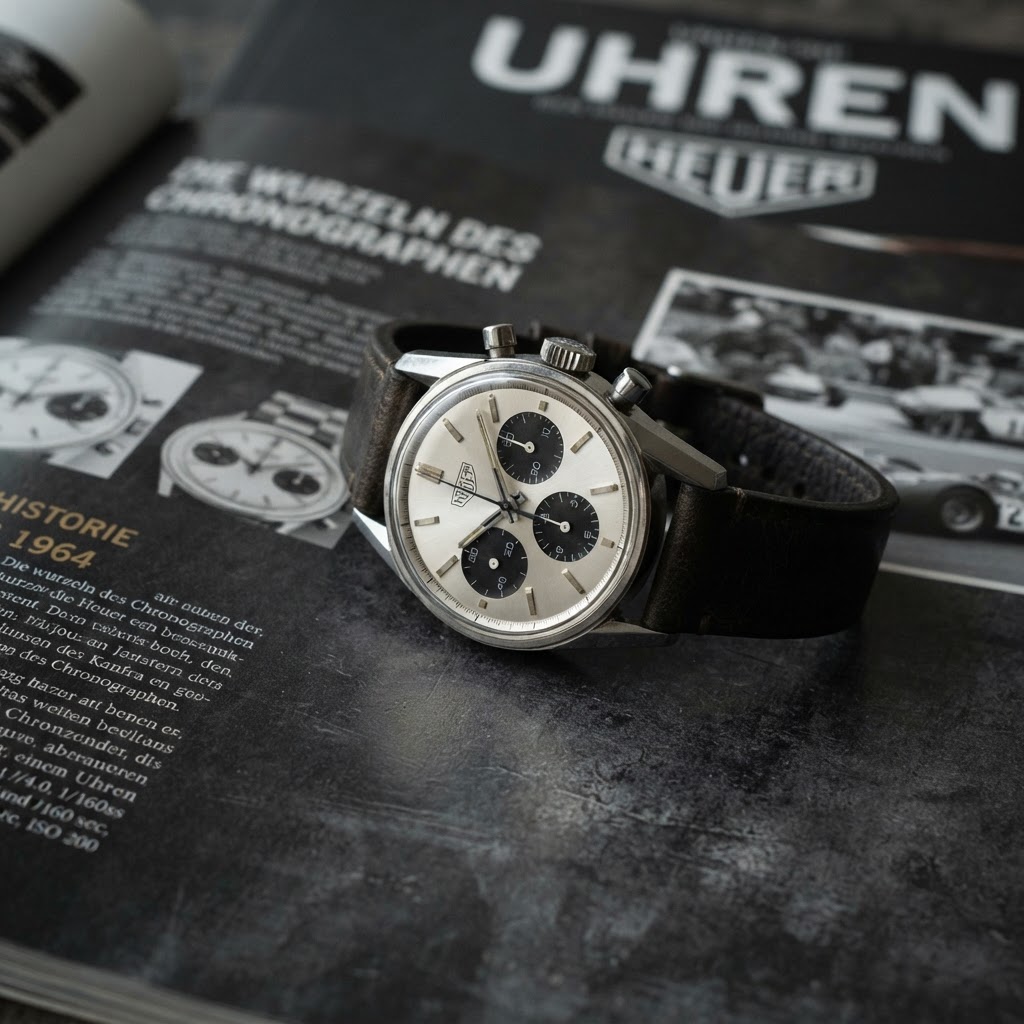
The vintage models from this era are highly sought-after collectibles today, bearing witness to an aesthetic that goes far beyond mere function. They embody a time when design met unwavering engineering. For the true enthusiast, a vintage Heuer is not just a timepiece, but a piece of motorsport history that can be worn directly on the wrist.
The Legacy of the Oscillating Pinion
A milestone in Heuer's development was undoubtedly the invention of the oscillating pinion in 1887. This ingenious device made it possible to design chronographs that were mechanically simpler and therefore more robust, which first enabled the mass proliferation of this complex complication. It was this technical foresight that made Heuer a preferred supplier for Olympic Games and legendary car races.
This technical superiority is still reflected in the vintage models today, which impress with their reliability. Collectors especially appreciate these watches because they demonstrate that quality endures over decades. Anyone who acquires a Heuer from the 1950s or 1960s today holds genuine industrial history in their hands.
Icons That Shaped Motorsport
In the 1960s and 1970s, the connection between Heuer and motorsports reached its absolute peak. Models such as the Carrera or the Autavia became icons that shaped the lifestyle of an entire generation. Names that were originally intended for the grueling conditions of endurance races quickly became synonymous with elegance and speed.
Anzeige
- Heuer Carrera: The timeless design for clear readability at high speeds.
- Heuer Autavia: The robust combination of automobile and aviation.
- Heuer Monaco: The revolution brought about by the first square, water-resistant case.
- Heuer Camaro: A cushion-shaped design gem that is extremely rare today.
A Design That Captured the Zeitgeist
The special feature of vintage Heuer watches is their remarkable versatility. They were tools worn on the wrist during rallies, but at the same time, they looked excellent with an elegant suit at an evening event. The dials are usually uncluttered, functional, and yet aesthetically perfectly balanced.
A Heuer on the wrist is not just a timepiece, but a promise to the perfection of the moment.
The patina on old dials and the gentle wear of the stainless steel cases tell stories of days gone by. Every scar on the case of a vintage Heuer gives it an individual character that no modern model can replicate. It is precisely this uniqueness that makes the hunt for these treasures so passionate and worthwhile.
The Value of Constancy
The market for vintage Heuer has grown enormously in recent years, which makes acquiring them significantly more demanding today. Nevertheless, investing in a well-preserved Heuer remains one of the safest and most emotionally satisfying options for watch enthusiasts. It is not just about the potential increase in value, but about the respect for craftsmanship.
For beginners, it is recommended to focus on authentic pieces with a traceable history. Do not hesitate to consult experts to ensure the originality of the components, because in the world of vintage watches, authenticity is the highest asset. A genuine Heuer will convince you not only with its value, but with the pride of preserving a piece of history.